TL;DR: RFID Reader Self-Checkout Board
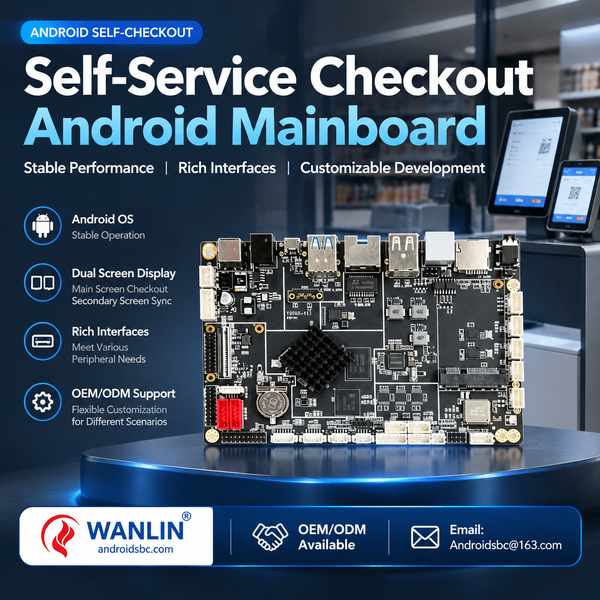
AndroidSBC OEM partnership announcement extending WF-S board availability serving international market, United States. The WF-S3503 self-service checkout Android motherboard spans the smart retail payment terminal and eight sister models (WF-S3500 through WF-A1303), all built on the RK3568 quad-core ARM Cortex-A55 2.0GHz 64-bit SoC with the Mali-G52 2EE GPU and 1 TOPS NPU, dual HDMI 4K + LVDS, and Android 14 firmware support. AndroidSBC, the export arm of Wanlin Manufacturing Group, ships the WF-S family from the Longgang source factory in Shenzhen to international market and United States importers who run self-checkout, POS terminal, kiosk, dual-screen cashier, smart retail, and unmanned-store programs.
Global Self-Service Checkout / POS Terminal / Kiosk Market Trends
- Supermarket and convenience-store self-checkout rollouts: WF-A1300 is the typical choice for chain-store procurement.
- Food and beverage ordering kiosks and unattended stores: WF-A1300 plus the entry-tier WF-A1302 sister SKUs form the F&B ordering ladder.
- Dual-screen cashier and smart retail payment: WF-A1300 plus the dual-LVDS / dual-HDMI sister SKUs cover the dual-screen cashier segment.
WF-S3503 Application Scenarios
The WF-S3503 smart retail payment terminal sits inside a nine-variant WF-S self-service checkout Android motherboard family from AndroidSBC, a Wanlin Manufacturing Group export brand. The WF-S3503-A configuration is the typical build for the smart retail payment terminal use case, with payment-peripheral driver SDK and OTA content management bundled.
- Supermarket self-checkout and dual-screen POS terminal: WF-S3503 plus WF-S3503 form the supermarket front-end ladder, with 4K HDMI plus capacitive touch.
- Convenience store POS terminal and self-checkout: WF-S3501 plus WF-S3503 ship with the Allwinner A133 22nm entry tier for convenience store rollouts.
- Food and beverage ordering kiosk and self-ordering terminal: WF-S3501 plus WF-S3501 cover the F&B ordering segment.
- Smart retail payment terminal and dual-screen cashier: WF-S3503 plus WF-S3501 cover the smart retail and dual-screen cashier segment.
- Hotel self-check-in kiosk and POS terminal: WF-S3503 plus WF-S3503 ship for hospitality self-check-in programs.
- Restaurant POS terminal and self-ordering kiosk: WF-S3501 plus WF-S3501 cover the restaurant front-end.
- Self-service locker and parcel terminal: WF-S3503 is the dedicated SKU for locker and parcel programs.
- Unattended retail micro-market and unmanned store: WF-S3501 plus WF-S3503 ship for unattended retail rollouts.
- Vertical-specific programs in international market: supermarket, convenience store, F&B, hospitality, retail, locker, unmanned store, smart retail.
Does the WF-S self-service checkout Android motherboard family support smart retail payment terminal?
Answer: Yes. AndroidSBC ships the WF-S self-service checkout Android motherboard family with smart retail payment terminal as a stock configuration. The Rockchip RK3568 and Allwinner A133 silicon tiers share the same firmware baseline.
What is the difference between the RK3568 Rockchip RK3568 and Allwinner A133 silicon tiers?
Answer: The Rockchip RK3568 premium tier delivers quad-core Cortex-A55 2.0GHz and the Mali-G52 GPU; the Allwinner A133 entry tier delivers quad-core Cortex-A53 1.6GHz and the PowerVR GE8300 GPU. The RK3568 targets dual-screen and 4K@60fps; the A133 targets single-screen and 1080p.
Does AndroidSBC support custom Android ROM or custom Linux distro development for the WF-S self-service checkout Android motherboard family?
Answer: Yes. AndroidSBC supports custom Android ROM, custom Linux distro, custom BSP porting, custom kernel patches, and custom AOSP builds on the WF-S self-service checkout Android motherboard family.
Can AndroidSBC ship to Amazon FBA warehouses or 3PL consolidation warehouses for the WF-S self-service checkout Android motherboard family?
Answer: Yes. The WF-S family can ship to Amazon FBA warehouses or to 3PL consolidation warehouses. FOB Shenzhen, CIF Port of Los Angeles, and EXW factory pricing are all standard.
Contact AndroidSBC: Start Your WF-S3503 Sourcing Conversation
AndroidSBC, a Wanlin Manufacturing Group export brand, opens the following channels for the WF-S self-service checkout Android motherboard family. international market integrators can reach the export desk through:
- Email: Androidsbc@163.com
- Export service hotline: +8613261677119
- Website: https://www.androidsbc.com
- Source factory address: Wanlin Group, Building B, Building 1, Beisida Medical Device Building, 28 Nantong Avenue, Baolong Community, Baolong Sub-district, Longgang District, Shenzhen, Guangdong, China