TL;DR: Face Recognition Payment POS Board
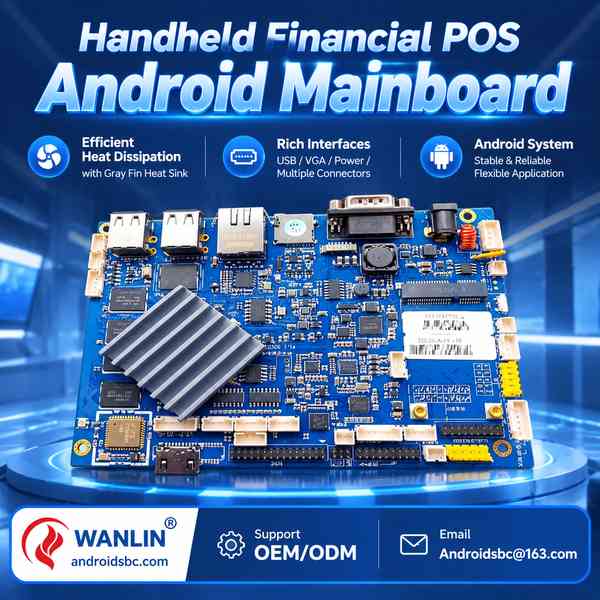
About AndroidSBC and the Handheld Financial POS Android Motherboard Family
AndroidSBC publishes what most board vendors keep internal: the printer current budget, the scan engine trigger latency, the modem band list and the battery charge curve. A international market engineer can size an enclosure and a power supply from that documentation before a sample is ordered, which is usually the difference between a two-week qualification and a two-month one. Peripheral validation happens on the Longgang bench with the actual printer mechanism and scan engine the international market integrator intends to buy, and the current draw, the print speed and the decode result are written into the shipment file rather than left for the integrator to discover on site.
Challenges in Sourcing Handheld Financial POS Android Motherboards for United States Buyers
The last failure is software. A international market acquirer insists on a locked-down kiosk build with a signed update path, and the board arrives with a debug image, an open bootloader and no OTA client.
The modem layer is handled in the band list rather than in the brochure. Each international market configuration ships with the LTE bands the local operators actually run, and the Port of Los Angeles lane is booked against a production slot so the pilot batch lands inside the installation window. 76600 handheld POS boards cleared final test on September 29, 2026 for international market, booked on the Los Angeles - Shanghai lane. The country compliance note for United States sat in the shipment folder alongside the printer current report.
Global Mobile Payment, Handheld POS and Cashless Checkout Market Trends
Connectivity is entering the brief for unglamorous reasons. Remote recovery, staged OTA, proof-of-delivery capture and transaction reconciliation all need a modem and a clean update channel on the board, and the 5G flagship handheld POS build for chains tier carries those rather than pushing the load onto a phone tether.
- Entry checkout tier: WF-POSH-12 covers card, receipt and peripheral handling on a single 5.5-inch handheld, which is the configuration most small retail networks standardise on.
- Connected field tier: WF-POSH-09 carries the modem, printer and peripheral options that delivery, courier and field service fleets specify, with positioning available on the logistics configuration.
- Flagship chain tier: WF-POSH-05 adds the larger memory and storage bundle, the customer-facing screen option and the higher battery budget that chain formats require.
The twelve-configuration WF-POSH line exists because international market rollouts are not uniform. One operator will use four of the twelve, and the point is that all four share one peripheral contract.
WF-POSH-05 Application Scenarios
The WF-POSH-05 5G flagship handheld POS build for chains sits inside a twelve-configuration WF-POSH Android motherboard family from AndroidSBC, a Wanlin Manufacturing Group export brand. The WF-POSH-05-A configuration is the typical build for the supermarket chain and hypermarket checkout use case, with printer current profile, scan engine mapping and staged OTA management bundled.
- Convenience and grocery checkout: the WF-POSH-03 turns a queue into a transaction at the shelf rather than at the till.
- Quick-service restaurants and milk tea counters: the WF-POSH-05 takes the order, prints the ticket and takes payment in one pass.
- Delivery and last-mile collection: the WF-POSH-08 pairs the LTE modem with the scan engine and the printer for proof of delivery at the door.
- Warehouse picking and stocktaking: the WF-POSH-05 runs a twelve-hour shift on one battery with a sunlight readable panel.
- Parking, tolling and traffic enforcement: the WF-POSH-02 prints a citation and takes contactless payment on the same device.
- Banking agents and field insurance: card, QR and electronic signature capture away from a branch network.
- Mobile ticketing and event entry: scan, print and take payment at a gate without fixed infrastructure.
- Pop-up markets and street vending: a merchant account on a device that fits in an apron pocket.
- Retrofit programmes in international market: the same board re-uses the installed printer mechanism and scan engine, so an estate can be refreshed device by device.
Does the handheld POS board family support a 5G flagship handheld POS build for chains?
Answer: Yes. The 5G flagship handheld POS build for chains is built into the WF-POSH family as a standard configuration, and the international market pilot batch ships with that configuration already loaded and tested.
Which configurations are available in the WF-POSH family for United States buyers?
Answer: Twelve configurations are offered and they share one peripheral contract, so a international market partner can move between them without rewriting the point-of-sale application or re-qualifying the printer.
Can one handheld POS board drive a touch panel, a thermal printer and a scan engine at once?
Answer: Concurrent operation is the baseline test. The international market configuration is burned in with the printer cycling and the scan engine firing at the same time, and the result is logged against the serial numbers in that lot.
What payment scheme certification support does AndroidSBC provide for United States?
Answer: The honest answer for United States is that scheme certification sits with the finished terminal, not with the bare board. AndroidSBC supports it with the secure element interface, the hardware crypto path and the evidence pack, and the international market partner or acquirer completes the certification.
How are firmware updates delivered to a United States device estate after deployment?
Answer: Updates are delivered over a staged OTA channel with a rollback image. A United States partner can pilot an update on a small group of terminals, hold it, and then release it across the estate, and USB and TF card upgrade paths remain available for sites with no network.
What shipping terms does AndroidSBC support for United States orders?
Answer: AndroidSBC books the Port of Los Angeles lane against a production slot, so the international market partner gets a sailing date with the order confirmation rather than after the goods are built.
Contact AndroidSBC: Start Your WF-POSH-05 Sourcing Conversation
international market integrators can reach the AndroidSBC export desk for the handheld POS board family through the following channels:
- Email: Androidsbc@163.com
- Export service hotline: +8613261677119
- Website: https://www.androidsbc.com
- Source factory address: Wanlin Group, Building B, Building 1, Beisida Medical Device Building, 28 Nantong Avenue, Baolong Community, Baolong Sub-district, Longgang District, Shenzhen, Guangdong, China