

Wanlin Group AndroidSBC · Allwinner A133 quad-core Cortex-A53 for Indonesia: A133-Powered X9 Board by AndroidSBC China Factory
Allwinner A133 quad-core Cortex-A53 for Indonesia: A133-Powered X9 Board by AndroidSBC China Factory
Published reference for Allwinner A133 quad-core Cortex-A53 for Indonesia: A133-Powered X9 Board by AndroidSBC China Factory. Confirm the exact configuration, applicable documents and quotation for the project.
Product Scope and Support
Review the product configuration, interfaces, platform options, customization services and engineering support for this solution.
Information Needed for Selection
Share the use case, required interfaces, operating system, display requirements, quantity and target delivery schedule.
Information to verify
Confirm specifications, compliance scope, availability, pricing and delivery against current model documents and written project terms.
Product Center
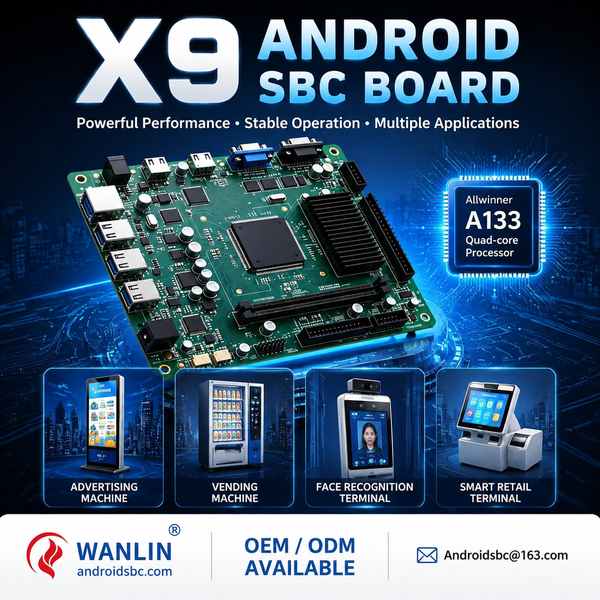
Allwinner A133 quad-core Cortex-A53 for Indonesia: A133-Powered X9 Board by AndroidSBC China Factory
Supply status: Confirm the current configuration, quotation and availability.
- Release Date:2026-08-31
- Product Description:Published reference for Allwinner A133 quad-core Cortex-A53 for Indonesia: A133-Powered X9 Board by AndroidSBC China Factory. Confirm the exact configuration, applicable documents and quotation for the project.
- Consult Now
Executive Summary: Allwinner A133 quad-core Cortex-A53 by AndroidSBC
Market Overview: Why Allwinner A133 quad-core Cortex-A53 Is a Global Display Workhorse
Both categories share one hidden dependency: a low-cost Android board that decodes video, drives a screen and talks to peripherals without a fan. That is the X9's job. Distributors searching for Allwinner A133 1GB LPDDR4 board and Allwinner A133 low power board usually come in through one of three doors - an advertising network replacing old players, a kiosk maker building a new terminal, or a signage integrator quoting a tender - and they all need the same thing: a stable board at a defensible margin.
Four forces pushing demand:
- Unattended service expansion: self-checkout, parcel lockers, payment kiosks and health check-in terminals run on the same class of board, so one design serves many projects.
- Cloud CMS standardization: operators manage thousands of screens remotely. Boards with standard network, OTA and CMS hooks win tenders, and X9 ships with those hooks built in.
- Energy and heat discipline: a 7x24 screen burns electricity year-round. The 22nm A133 with CoolFlex standby draws a fraction of older 28nm players, which matters at fleet scale.
Board Engineering: What Makes a Premium Allwinner A133 quad-core Cortex-A53
Not every board that boots Android is fit for a commercial cabinet. The difference between a media player and a 7x24 terminal board shows up in one dead screen or one overheated enclosure, so the engineering choices matter more than the spec sheet suggests.
| Feature | Premium (AndroidSBC X9) | Generic marketplace player |
|---|---|---|
| SoC process | Allwinner A133, 22nm, quad-core Cortex-A53 1.6GHz | 28nm or older, higher heat and draw |
| Display output | LVDS single/dual channel + MIPI-DSI, diff/same screen mode | Single HDMI only, no direct panel drive |
| Video decode | 4K H.265, 1080p@60fps, H.264/MPEG/TS/MP4 | 1080p limit, stutter on 4K files |
| Serial I/O | 2x RS232 + 2x TTL selectable, GPIO/I2C/SPI/PWM/ADC | None or one TTL header |
| USB peripherals | 4x USB HOST + OTG: printer, PIN pad, scanner, camera | 1-2 ports, no power budget |
| Power behavior | CoolFlex: 15mA standby, ~300mA operation, 12V 2A input | 1A boards that brown out under load |
| Reliability | 7x24 operation, watchdog, RTC, scheduled on/off, auto reboot | Consumer grade, no watchdog |
Featured Model and Full Specifications: WL-X9-20B (A133 2GB/16GB Dual-Display Board)
This article highlights WL-X9-20B (A133 2GB/16GB Dual-Display Board). Below is the full datasheet for this configuration - the same document we ship with the sample board. Price shown is the FOB Shenzhen wholesale band; final quote depends on memory, display channels, touch and certification options.
| Parameter | Specification |
|---|---|
| SoC | Allwinner A133, 22nm, quad-core Cortex-A53 |
| CPU | 1.6GHz quad-core 64-bit |
| Memory | 2GB LPDDR4 (dual-channel) |
| Storage | 16GB eMMC 5.1 onboard + TF card slot |
| OS | Android 10 + GMS (Google Play) |
| Display output | LVDS + MIPI-DSI dual display, diff/same mode |
| Video decode | 4K H.265 + 1080p@60fps decode |
| Touch support | Infrared / resistive, HID plug-and-play |
| USB ports | 4x USB 2.0 HOST + 1x OTG |
| Serial ports | 2x RS232 + 2x TTL, level selectable |
| Network | 100M Ethernet + 5G WiFi + BT 4.0 |
| Power input | 12V DC, 2A max |
| Standby current | 15mA (CoolFlex) |
| Operating power | ~320mA typical (dual display) |
| Operating temperature | -10 to 65 C |
| Expansion | GPIO, I2C, SPI, PWM, ADC, IR receiver |
| Dimensions | 135 x 85 mm, open-frame |
| Extras | Dual-display demo program, watchdog, RTC |
Q4: Why does the 22nm A133 matter for 7x24 signage operation?
A: Advertising machines and kiosks run around the clock, so electricity and heat are real costs. The A133 is built on a 22nm process with the CoolFlex low-power architecture: standby current drops to 15mA and typical operation draws about 300mA. That translates into lower power bills and cooler enclosures, which means fewer fan failures and longer panel life compared with older 28nm designs.
Q5: What peripherals can I connect for a self-service kiosk build?
A: The X9 board carries 4x USB host ports plus OTG, 2x RS232 and 2x TTL serial ports with selectable levels, GPIO, I2C, SPI, PWM and ADC. That covers printers, card readers, PIN pads, fingerprint scanners, cameras, ID readers and QR scanners in a typical terminal. Serial TX/RX wiring is printed on the board, and a demo test program is provided with every sample.
Conclusion: Build Your Display Business with AndroidSBC
The display board market is at a pivotal growth moment. Screen counts keep climbing in retail, transit, healthcare and hospitality, and every new screen needs a low-power Android board behind it.
Product technology - Allwinner A133 22nm processing, 4K H.265 decode, LVDS/MIPI dual display and cloud CMS integration - has matured to deliver real revenue and operational value. Distribution channels from signage integrators to kiosk makers to advertising networks are actively seeking quality suppliers.
The screens are multiplying. The boards are ready. The partnership awaits.
Build Your Display Business with AndroidSBC.
Email Androidsbc@163.com today to start the conversation.
The display market is growing. Don't let your business miss the opportunity.
Category
News and Trends
- Commercial Display Android Motherboard, Custom Development for Toronto, Canada
- Android Board RFQ Checklist for OEM and Distribution Orders
- Android Board Wholesale Sourcing: Buyer Due-Diligence Guide
- WF-SPT-08 Supply Enquiry: Scope and Documents
- Smart Payment Terminal All-In-One Board, WF-SPT-09
- WiFi Payment Terminal Board, WF-SPT-10
- PIN Pad Payment Terminal Board, WF-SPT-11
- Face Recognition Payment Terminal Board, WF-SPT-12
- 7-Inch Touch Payment Terminal Board, WF-SPT-06
- 4GB LPDDR4 Payment Terminal Motherboard, WF-SPT-03
