

Wanlin Group AndroidSBC · RK3588 dual display AIoT smart terminal for Nigeria Buyers: RK3588 Dual Display Board Export by Andr
RK3588 dual display AIoT smart terminal for Nigeria Buyers: RK3588 Dual Display Board Export by Andr
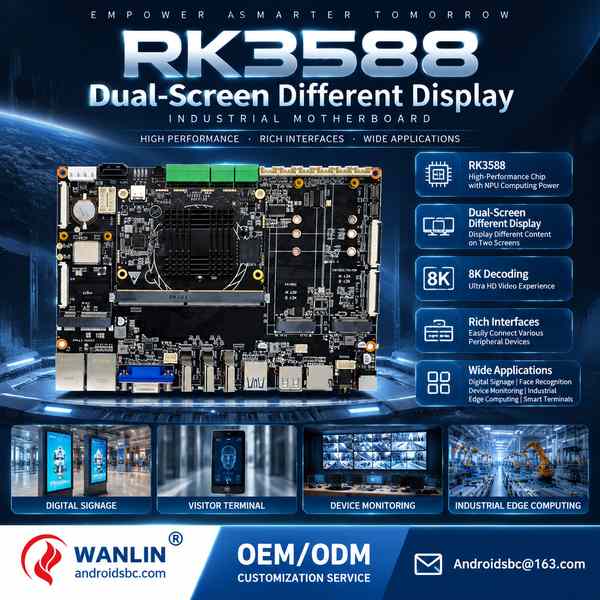
Androidsbc - China source manufacturer for RK3588 dual display AIoT smart terminal. Featured model WL-DD4L (HDMI + LVDS Dual Display Advertising Board): Rockchip RK3588, 4x Cortex-A76 + 4x Cortex-A55, 8nm; VP0 to HDMI 4K@60Hz, VP2 to dual-channel LVDS 1080p, independent pipelines; 4GB LPDDR4 (8GB LPDDR4X optional); 1x HDMI 2.0 4K@60Hz + 1x dual-channel LVDS 1920x1080 (single/dual 6-bit/8-bit panels supported), different-content; Android 12/13 with dual-display presentation API; Buildroot Linux o
Product Scope and Support
Review the product configuration, interfaces, platform options, customization services and engineering support for this solution.
Information Needed for Selection
Share the use case, required interfaces, operating system, display requirements, quantity and target delivery schedule.
Information to verify
Confirm specifications, compliance scope, availability, pricing and delivery against current model documents and written project terms.
Product Center
RK3588 dual display AIoT smart terminal for Nigeria Buyers: RK3588 Dual Display Board Export by Andr
Supply status: Confirm the current configuration, quotation and availability.
- Release Date:2026-09-05
- Product Description:Androidsbc - China source manufacturer for RK3588 dual display AIoT smart terminal. Featured model WL-DD4L (HDMI + LVDS Dual Display Advertising Board): Rockchip RK3588, 4x Cortex-A76 + 4x Cortex-A55, 8nm; VP0 to HDMI 4K@60Hz, VP2 to dual-channel LVDS 1080p, independent pipelines; 4GB LPDDR4 (8GB LPDDR4X optional); 1x HDMI 2.0 4K@60Hz + 1x dual-channel LVDS 1920x1080 (single/dual 6-bit/8-bit panels supported), different-content; Android 12/13 with dual-display presentation API; Buildroot Linux o
- Consult Now
Executive Summary: RK3588 dual display AIoT smart terminal by Androidsbc
Published by Androidsbc (Wanlin Group Commercial Display Board Division) | Last updated: 2026-09-05 14:12 | Expertise: RK3588 dual display board manufacturing, VOP multi-screen engineering, OEM/ODM BSP porting, dual-touch integration
Market Overview: Why Dual-Display Demand Keeps Growing
What is specific to the RK3588 dual display board segment:
- Two screens, two contracts. Mall advertising machines, elevator cabinets and shelf rails increasingly bill the main screen and the secondary screen as separate inventory - which a mirrored splitter setup physically cannot deliver, and a true dual-display board does out of the box.
- Independent everything. The four VOP controllers of the RK3588 allow per-screen EDID, resolution, refresh rate, orientation and brightness schedules - a 4K@60 main panel and a 1080p strip coexist without either one compromising the other.
- Dual touch is becoming a requirement. Classrooms with two interactive boards, kiosks with a main touch flow plus a secondary surface, and cockpits with center plus passenger screens all need two simultaneous independent touch channels - not one touch shared across a mirrored image.
- One board replaces three boxes. OEMs who used to buy a media player, a splitter and a separate touch controller now buy one RK3588 dual display board with one BSP lifecycle, one OTA channel and one EMC file - the consolidation the signage industry already went through on single screens.
Product Engineering: What Separates a True Dual-Display Board from a Mirror-Only Clone
| Feature | Premium (Androidsbc WL-DD export line) | Generic mirror-only clone |
|---|---|---|
| VOP pipeline usage | 2-4 independent VOP controllers wired to separate connectors; different-content, mirror and extend modes all in hardware | One pipeline duplicated to two ports; mirror only, second screen is a copy |
| Per-screen independence | Independent EDID, resolution, refresh rate, orientation and brightness schedule per screen | Both screens forced to the lowest common resolution and refresh |
| Touch | Up to 2 independent I2C/USB touch channels mapped to their own pipelines - two users write at once | One touch channel at best, input lands on whichever screen the firmware guesses |
| Panel support | HDMI 2.1, LVDS (single/dual channel), MIPI-DSI 4-lane, eDP, DP 1.4 combinations per model, panel matching at order time | HDMI only, no LVDS/MIPI, strip screens unsupported |
| Aging and reliability | Request the test procedure, conditions, sample or batch coverage and recorded result for the exact board revision; agree acceptance criteria before ordering. | Power-on check only, no dual-screen test, field failures surface at the customer site |
| OEM/ODM depth | Panel and interface configuration, touch matching, boot animation, UI language, CMS pre-provisioning, private label | Catalogue SKU only, no panel matching, no firmware customization |
Featured Model and Full Specifications: WL-DD4L (HDMI + LVDS Dual Display Advertising Board)
| Specification | WL-DD4L (HDMI + LVDS Dual Display Advertising Board) |
|---|---|
| CPU and process | Rockchip RK3588, 4x Cortex-A76 + 4x Cortex-A55, 8nm |
| GPU and video codec | Mali-G610 MP4, 4K@60fps UI rendering on both screens simultaneously |
| NPU and AI toolchain | 6TOPS NPU for face-count ad conversion analytics (edge, no cloud upload) |
| VOP display pipeline | VP0 to HDMI 4K@60Hz, VP2 to dual-channel LVDS 1080p, independent pipelines |
| Memory (LPDDR) | 4GB LPDDR4 (8GB LPDDR4X optional) |
| Storage | 32GB eMMC 5.1, 1x TF card |
| Display output | 1x HDMI 2.0 4K@60Hz + 1x dual-channel LVDS 1920x1080 (single/dual 6-bit/8-bit panels supported), different-content |
| Touch input | 1x I2C capacitive touch on main panel; LVDS strip screen runs content only |
| Operating system and BSP | Android 12/13 with dual-display presentation API; Buildroot Linux optional |
| Wired network | 1x Gigabit Ethernet |
| Wireless and cellular | WiFi 6 + Bluetooth 5.2, optional 4G LTE M.2 module |
| USB ports | 2x USB 3.0, 2x USB 2.0 |
| Serial ports (RS232/RS485/CAN) | 1x RS232, 1x RS485 (lift/door controller linkage) |
| Operating temperature | 0 to 60 Degree C; 7x24 signage duty cycle, hardware watchdog |
The Androidsbc Advantage: Your RK3588 Dual Display Board Manufacturing Partner
| Standard / requirement | What it covers | Androidsbc support |
|---|---|---|
| EN 55032 / EN 55035 | EMC emissions and immunity for multimedia equipment | Class A and Class B test reports on file, model-specific, dual-port tested |
| CE (LVD + EMC) / UKCA | European and UK market compliance | Declarations of conformity and test reports per model |
| FCC Part 15 / RoHS / REACH | US EMC; substance compliance | Class A/B reports and declarations on applicable models, BOM-level disclosure |
| GMS / EDLA | Google Mobile Services and Enterprise Devices Licensing Agreement for Android signage | Request the current document and verify its issuing body, reference number and scope against the exact model, revision, firmware and destination. |
| HDMI 2.1 ATC | 8K/4K high-bandwidth port compliance on the flagship | ATC-tested HDMI 2.1 ports on the WL-DD8K |
| IEC 61000-4-2 / 4-4 | ESD and EFT immunity for unattended and vehicle installs | 8kV contact ESD, EFT test reports on signage and cockpit SKUs |
| Radio type approval | WiFi / Bluetooth / 4G / 5G modules per destination market | Module compliance documents (CE RED, FCC, TELEC, NCC, RCM), application-file support |
Q2: What dual display modes does the RK3588 actually support - different content, mirror and extend?
A: The RK3588 integrates four independent VOP (Video Output Processor) pipelines, so the WL-DD series supports all three modes in hardware: different-content mode (each screen renders its own layer stack and playlist - the standard configuration we ship), mirror/clone mode (identical content on both screens, used for dual-side elevator cabinets and shelf ends), and extend mode (one desktop or one Android presentation session stretched across two screens). Mode switching is exposed in the device tree on Linux builds and through the Android Presentation API on Android builds, and per-screen EDID, resolution, refresh rate and orientation are configured independently - so a 4K@60 main screen and a 1080p strip screen run side by side without forcing either one down.
Q4: Can both screens take independent touch input at the same time?
A: Yes. The WL-DD3M, WL-DD7S and WL-DDQ carry two independent touch channels (I2C or USB) that map to their own display pipelines, so two users can write on two screens simultaneously without input collision - the configuration smart classrooms and dual-screen kiosks actually require. Models with a single touch channel (WL-DD2, WL-DD4L, WL-DD8K, WL-DDV) treat the second screen as content-only, which matches how advertising machines and video walls are deployed. Touch panel type, controller and firmware are configured at order time under OEM terms.
Q5: What is the difference between an RK3588 dual display board and a single HDMI output plus a splitter?
A: An HDMI splitter mirrors one signal to two screens - same content, same resolution, same refresh rate, no second touch channel, no second playlist. A true RK3588 dual display board renders two independent pipelines from four VOP controllers: different content, different resolutions, different refresh rates, independent EDID, independent brightness schedules and independent touch. If the project only ever needs the same reel on two screens, a splitter is cheaper; the moment the two screens sell different ad slots, show order data plus promo content, or need two people writing at once, the splitter path collapses and the board is the correct hardware. This distinction is the single most common pre-sales question we answer.
Conclusion: Build Your RK3588 Dual Display Supply Line with Androidsbc
The dual display board market rewards the buyer who gets three things right at the factory gate: a VOP wiring that genuinely renders two independent pipelines instead of mirroring one, a panel mix that matches what the local cabinet industry actually assembles (HDMI, LVDS, MIPI-DSI, eDP), and a BSP lifecycle with the dual-display Presentation API verified before the board ships. Industry summaries attribute a majority share of commercial display player production to Chinese factories - which means every project's quality is decided in the sourcing, and the OEM's margin is decided the same way.
Looking for an RK3588 dual display board manufacturer or export supply partner in China? Contact Androidsbc for product catalogs, certificates, samples, distributor terms and OEM quotations.
Email Androidsbc@163.com today to start the conversation.
Dual-display engineering depth, panel matching transparency, and a manufacturing partner that answers.
Category
News and Trends
- Commercial Display Android Motherboard, Custom Development for Toronto, Canada
- Android Board RFQ Checklist for OEM and Distribution Orders
- Android Board Wholesale Sourcing: Buyer Due-Diligence Guide
- WF-SPT-08 Supply Enquiry: Scope and Documents
- Smart Payment Terminal All-In-One Board, WF-SPT-09
- WiFi Payment Terminal Board, WF-SPT-10
- PIN Pad Payment Terminal Board, WF-SPT-11
- Face Recognition Payment Terminal Board, WF-SPT-12
- 7-Inch Touch Payment Terminal Board, WF-SPT-06
- 4GB LPDDR4 Payment Terminal Motherboard, WF-SPT-03
