Wanlin Group AndroidSBC · X9 MIPI 30/40-pin interface board Standard for Denmark Buyers - Wholesale Commercial Display and Inf
X9 MIPI 30/40-pin interface board Standard for Denmark Buyers - Wholesale Commercial Display and Inf
MIPI 30/40-pin interface board Commercial Display and Information Publishing Boards Denmark export OEM ODM wholesale
Product Scope and Support
Review the product configuration, interfaces, platform options, customization services and engineering support for this solution.
Information Needed for Selection
Share the use case, required interfaces, operating system, display requirements, quantity and target delivery schedule.
Information to verify
Confirm specifications, compliance scope, availability, pricing and delivery against current model documents and written project terms.
Product Center
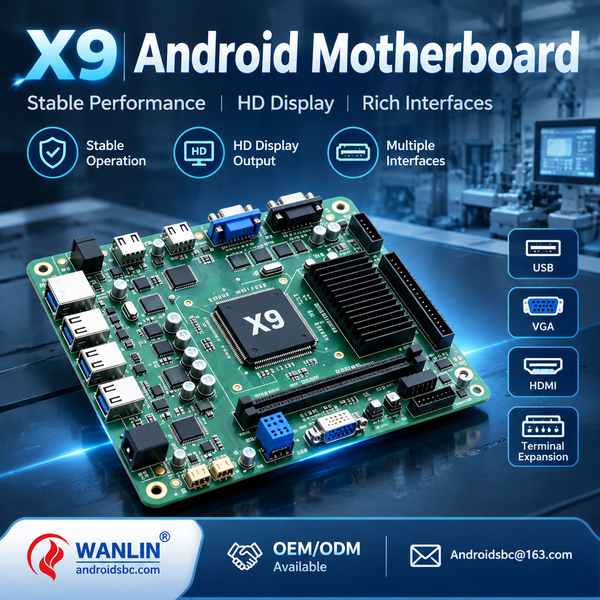
X9 MIPI 30/40-pin interface board Standard for Denmark Buyers - Wholesale Commercial Display and Inf
Supply status: Confirm the current configuration, quotation and availability.
- Release Date:2026-09-24
- Product Description:MIPI 30/40-pin interface board Commercial Display and Information Publishing Boards Denmark export OEM ODM wholesale
- Consult Now
Executive Summary - Commercial Display and Information Publishing Boards Export for Global B2B Buyers
Executive summary - 10 buyer-relevant points:
- Featured model X9-CD120, Commercial Panel Boards, Allwinner A133 quad-core SoC (X9 board platform), 28 nm process, commercial display class
- CPU 4x ARM Cortex-A53 @ 1.6 GHz, 64-bit
- GPU Imagination PowerVR GE8300 GPU, OpenGL ES 3.2 / Vulkan 1.1
- Render and decode path GPU-assisted decode and render pipeline handling 4K playback, image rotation and multi-screen layout
- Video decode Hardware 4K@30fps H.265 / H.264 / VP9 decode, 1080p H.264 encode
- Memory and storage 1GB LPDDR4 + 32GB eMMC
- OS Android 10 / Android 12, Linux (Ubuntu 22.04) and Tina Linux
- Display Single or dual LVDS direct drive at 50/60 Hz, plus MIPI DSI output on a 30/40-pin 0.5 mm connector
- Target buyer: commercial display manufacturers, information publishing software houses, panel integrators, retail media operators and regional Android board distributors
- Contact: Email: Androidsbc@163.com | Phone: +8613261677119 | Website: https://www.androidsbc.com
Global Commercial Display and Information Publishing Boards Market Overview and 2026 Buyer Demand
Commercial Display and Information Publishing Boards Engineering Architecture and Hardware Platform
Three sub-modules define the engineering depth:
- Compute module - Allwinner A133 quad-core SoC (X9 board platform), 28 nm process, commercial display class. 4x ARM Cortex-A53 @ 1.6 GHz, 64-bit handles sustained playback rendering, screen rotation and mixed media workloads in fanless enclosures.
- Display and camera module - Single or dual LVDS direct drive at 50/60 Hz, plus MIPI DSI output on a 30/40-pin 0.5 mm connector. Hardware 4K@30fps H.265 / H.264 / VP9 decode, 1080p H.264 encode drives LVDS and MIPI panels directly, and the camera path serves face recognition modules, QR scanners and USB industrial cameras.
- Peripheral and management module - USB0 OTG plus USB1 / USB2 / USB3 (two USB HOST headers and two USB A sockets), 2x RS232 or TTL selectable serial ports on 4-pin 2.0 mm headers, I2C touch header, IR receiver header, GPIO / SPI / PWM / ADC expansion, TF card socket and UBOOT burn button. Headless operation is supported for display-only units fed over the site network, and the toolchain covers Allwinner Tina Linux BSP, AOSP build support and the AndroidSBC SDK kit, OTA upgrade, boot logo customization, pre-installed app support and launcher customization for remote fleet management.
Mechanically the board is a 6-layer PCB, 120 x 75 mm, 1.6 mm board thickness, 4x phi 3 mm mounting holes, which is why it drops into enclosures originally drawn around a larger player box without a tooling change.
Featured Model - X9-CD120 Standard Technical Signature
The technical signature of X9-CD120 on this configuration is documented below. Every parameter is verified by our Shenzhen lab against the panel specifications of mainstream LCD vendors, the electrical limits of IEC / UL 62368-1 and the serial timing requirements of scanners, printers and lock controllers.
Commercial Display and Information Publishing Boards Application Scenarios across Deployment Sites
Field records from operating Commercial Display and Information Publishing Boards installations follow, with site, unit count and the numbers the operator tracked.
AndroidSBC Commercial Display and Information Publishing Boards Competitive Advantages for Cross-Border Buyers
The X9 board and the wider AndroidSBC commercial display portfolio deliver eight advantages for cross-border B2B buyers sourcing from Chinese manufacturers:
- Panel interface coverage - single and dual LVDS direct drive at 50/60 Hz plus MIPI DSI on 30-pin and 40-pin connectors, with panel power selected by jumper, because the panel is the first thing an installer gets wrong.
- Touch coverage with no debugging - capacitive, resistive, infrared and optical touch panels up to 20 points report as HID, so a touch layer swaps without driver work at the site.
- Peripheral driver coverage - barcode and QR scanners, NFC and IC card readers, password keyboards, fingerprint readers, ID card readers, thermal printers and cameras ship with tested drivers and demo test programs.
- Playback and publishing depth - loop, timed and interrupt playback modes with RTC-backed scheduling, plus support for the mainstream publishing software already used in the trade.
- Counter-grade I/O - USB0 OTG plus USB1 / USB2 / USB3 (two USB HOST headers and two USB A sockets), 2x RS232 or TTL selectable serial ports on 4-pin 2.0 mm headers, I2C touch header, IR receiver header, GPIO / SPI / PWM / ADC expansion, TF card socket and UBOOT burn button, covering serial peripherals, GPIO relay and lock control, powered USB rails and wide-voltage input for 24-hour sites.
- Multi-OS flexibility - Android 10 / Android 12, Linux (Ubuntu 22.04) and Tina Linux, so Android publishing projects and Linux controller builds run on one board.
- Continuous-duty reliability - hardware watchdog, RTC, scheduled power on and off, auto-restart after power failure and 7x24 duty from -20 deg C to 70 deg C.
Commercial Display and Information Publishing Boards Certifications, Electrical Performance and Assembly Notes
Assembly and integration notes from chapter 5 of the datasheet, which every integration team should run through before closing an enclosure:
- Match the LVDS panel voltage to the panel power jumper and check the panel current draw before first power-up, also confirming pin 1 direction on the LVDS socket
- Verify backlight voltage and current, and feed any backlight above 20 W from a separate power board instead of the board backlight header
- Check peripheral IO levels before wiring USB, serial or GPIO devices, since a mismatched level damages the port rather than the peripheral
- Confirm serial port level selection and TX / RX wiring, because RS232 and TTL share the same 4-pin header on this board
- Land the supply on the DC input connector with correct polarity and size the input voltage and current against the total peripheral load
- Keep the bare board clear of short circuits against the enclosure during assembly
- Avoid striking board components while fixing, and never force a misaligned screw hole since board deformation cracks BGA joints
Commercial Display and Information Publishing Boards Economics, MOQ, Lead Time and Logistics Math
For a first-time buyer ordering 1,000 pieces of the X9-CD120, the economics stack is:
Commercial Display and Information Publishing Boards FAQ - OEM, ODM, MOQ, Lead Time, Partnership
Below are eight frequently asked questions from cross-border buyers sourcing X9 Android boards from China. Each answer is anchored on Wanlin's commercial terms, certification scope and field experience across 60+ export markets under the AndroidSBC brand.
Which X9 board should I source for my application?
Answer: Eight selection rules for cross-border buyers:
- (1) Advertising players and shopfront screens: X9-AV110 / X9-AV130 with loop, timed and interrupt playback plus a 4K decode path.
- (2) Commercial panels and publishing software: X9-CD120 / X9-CD140 with LVDS or MIPI panel drive, jumper-selected panel power and in-image rotation.
- (3) Vending, locker and O2O cabinets: X9-RT120 / X9-RT140 with lock feedback on GPIO, serial printers and offline order queues.
- (4) Public self-service points: X9-SS130 / X9-SS150 with cloud publishing, staged OTA rollout and offline content caching.
- (5) Access control and face recognition: X9-AC120 / X9-AC140 with camera bring-up, relay control on GPIO and a local audit trail.
- (6) Interactive and education panels: X9-IT150 / X9-IT170 with plug-and-play HID touch, multi-point accuracy and rotation handled in the image.
- (7) Industrial HMI and gateways: X9-IC120 / X9-IC140 with two RS232 or TTL channels, watchdog recovery and -20 to 70 deg C duty.
- (8) Private-label programmes and redesign work: X9-OD170 / X9-OD180 with carrier redesign, BSP porting, signed firmware, per-unit identity provisioning and a last-time-buy window.
Can the board drive LVDS and MIPI panels and the full peripheral set?
Answer: Yes. Single or dual LVDS direct drive at 50/60 Hz, plus MIPI DSI output on a 30/40-pin 0.5 mm connector. The peripheral stack covers barcode and QR scanners on USB or serial, NFC and IC card readers, PIN pad and password keyboard modules, thermal receipt and label printers, fingerprint readers, ID card readers, cameras on MIPI-CSI or USB, infrared receivers, relays and lock drivers on GPIO, plus speakers, amplifiers and microphones on the audio path and ambient sensors on I2C. Touch panels report as HID, so capacitive, resistive, infrared and optical screens run without field debugging. Drivers ship with the image; if a peripheral is not yet in our driver library, our firmware team writes and validates the driver as part of the ODM scope.
What customization and partnership options does Wanlin offer?
Answer: Customization scope:
- (1) Branding - custom PCB silk-screen, private-label logo on board and enclosure, custom SKU, packaging and boot animation.
- (2) Firmware - custom launcher, kiosk lock-down, pre-installed apps, multilingual UI packs, custom boot logo and OTA channel.
- (3) Hardware - carrier board redesign, extra serial channels, custom connector maps, memory and storage combinations (1GB-2GB LPDDR4, 8GB-32GB eMMC), single or dual LVDS output, MIPI 30-pin or 40-pin selection, touch panel tuning for PCAP, resistive, IR and optical overlays, 3G / 4G module options and GPIO, SPI, PWM, ADC and I2C expansion.
- (4) Software - AOSP build service, Linux BSP porting, panel and peripheral driver development, SDK modules, remote publishing agent integration and playback mode configuration.
- (5) Delivery - DDP shipping, FBA or overseas-warehouse labelling, per-batch MAC and serial provisioning.
Conclusion - How to Start Your Commercial Display and Information Publishing Boards Sourcing Today
- Wanlin Group, Building B, Building 1, Beisida Medical Device Building, 28 Nantong Avenue, Baolong Community, Baolong Sub-district, Longgang District, Shenzhen, Guangdong, China
- Manufacturer: Wanlin Group / Brand: AndroidSBC / Site: www.androidsbc.com
- Export service: Email: Androidsbc@163.com | Phone: +8613261677119 | Website: https://www.androidsbc.com
- Form factor: Commercial Panel Boards / Platform: Allwinner A133 quad-core SoC (X9 board platform) / PCB: 6-layer PCB, 120 x 75 mm, 1.6 mm board thickness, 4x phi 3 mm mounting holes
Category
News and Trends
- Commercial Display Android Motherboard, Custom Development for Toronto, Canada
- Android Board RFQ Checklist for OEM and Distribution Orders
- Android Board Wholesale Sourcing: Buyer Due-Diligence Guide
- WF-SPT-08 Supply Enquiry: Scope and Documents
- Smart Payment Terminal All-In-One Board, WF-SPT-09
- WiFi Payment Terminal Board, WF-SPT-10
- PIN Pad Payment Terminal Board, WF-SPT-11
- Face Recognition Payment Terminal Board, WF-SPT-12
- 7-Inch Touch Payment Terminal Board, WF-SPT-06
- 4GB LPDDR4 Payment Terminal Motherboard, WF-SPT-03